
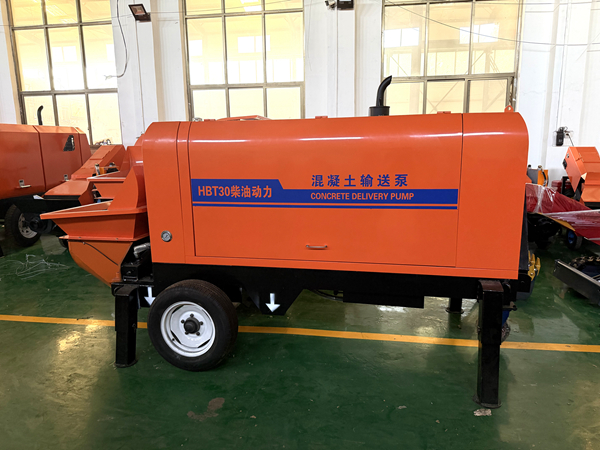
Core Technical Parameters (Common Industry Version)
·Theoretical output: 30 m³/h, stable output under actual working conditions is 22–26 m³/h
·Power: 4105 turbocharged four-cylinder diesel engine (about 56–85 kW), with its own fuel tank
·Maximum pumping pressure: 10–13 MPa, supports high/low pressure switching
·Conveying distance: vertical 60–90 m, horizontal 150–180 m
·Conveyable aggregate: pebble ≤40 mm, crushed stone ≤30 mm; ordinary ready-mixed concrete, fine aggregate and mortar are all acceptable
·Delivery pipeline: DN100 / DN125
·Distribution valve: S valve, twin-cylinder hydraulic piston pumping, air / water dual cooling, hopper with agitation
·Overall weight: about 2400–2800 kg, with a trailer chassis and towing hook, can be towed by tractor / truck for relocation
·Control: wired + wireless remote control, one-key switching between forward and reverse pumping, reverse suction when blocked
Working Principle
The diesel engine drives the main hydraulic pump, which pushes the main oil cylinder to move the concrete pistons; the S valve alternately completes suction and discharge, conveying the concrete continuously along the pipeline for pouring. The dual cooling system is suitable for long continuous operation.
Applicable Project Scenarios
1. Field and mountain areas, river embankment slope protection, channels, photovoltaic foundations, and sites without a 380 V power supply
2. Main structure pouring of multi-storey houses and township small buildings; ground beams, columns and floors
3. Small tunnels, foundation pit blinding, retaining walls and rural road concrete
4. Small and medium secondary structures, floor heating backfill and floor fine aggregate concrete
Suitable for: sites that need higher and farther conveying and larger pouring volumes than the Model 20, and that lack power on site
Main Advantages
1. Diesel power works with or without electricity, so field sites are not restricted by power supply
2. Greater power and pumping pressure than the Model 20, with a longer conveying distance; can handle ordinary concrete with larger stones, not limited to fine aggregate
3. Trailer structure with tyres on the whole machine, convenient for short-distance relocation
4. Dual cooling allows long continuous pouring; with reverse pumping, blockages are easier to clear
5. Built-in hopper agitation reduces aggregate segregation and gives smooth feeding
Limitations
1. Compared with electric pumps: higher noise and exhaust emissions; the engine needs regular maintenance (engine oil, three filters), and the operating cost includes diesel consumption
2. Heavier than the Model 20, so it is not as easy to move in and out of confined sites as the Model 20
3. Not suitable for high-rise work (over 90 m) or extra-large-volume projects; not comparable to the Model 40/60 large ground pumps
4. Also has requirements on concrete slump; if the mix is too dry or the stone is oversized, blockages can still occur easily
Brief comparison with the Model 20 delivery pump
|
Item |
Model 20 (mostly fine aggregate pumps) |
Model 30 Diesel Ground Pump |
|
Theoretical Output |
20m³/h |
30m³/h |
|
Conveying Height |
40–50m |
60–90m |
|
Maximum Aggregate Size |
Mainly 20–25 mm fine aggregate |
30–40 mm, can pump ordinary concrete |
|
Power |
22/30 kW motor, a few diesel versions |
4105 turbocharged diesel engine |
|
Overall Weight |
900–2.6 t |
2.4–2.8 t |


