
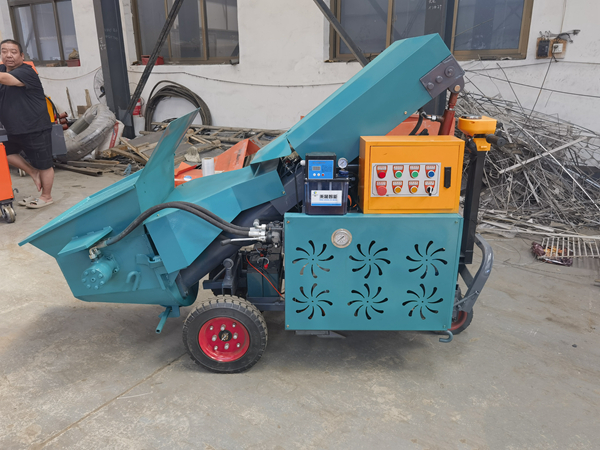
Its full name is inclined concrete pump (inclined secondary-structure pump), and it belongs to the small fine aggregate pump class. Unlike the horizontal ground pumps of the Model 20/30 above, the oil cylinder and delivery cylinder are arranged at an overall incline, the hopper is lower and the feeding slope is smooth. It focuses on secondary-structure pouring and comes in electric and diesel versions.
Core Technical Parameters (Mainstream Version)
·Theoretical output: 6–10 m³/h, actual 4–8 m³/h
·Power: electric version 15 kW / 22 kW; diesel version single-cylinder / twin-cylinder diesel engine
·Pumping pressure: 6–8 MPa
·Conveying distance: vertical 20–30 m, horizontal 50–80 m
·Conveyable aggregate: stone ≤20–25 mm (mainly fine aggregate and mortar)
·Delivery pipeline: DN80
·Distribution valve: S valve, inclined cylinder structure
·Overall weight: 350–600 kg, with swivel wheels, can be pushed and pulled in indoor corridors
·Control: wired + wireless remote control, one-key switching between forward and reverse pumping
·Hopper: low inclined hopper, material does not need to be lifted high, easy feeding by hand / small loader
Working Principle
The inclined oil cylinder pushes the inclined delivery piston, and the S valve alternately sucks and discharges material. With the inclined structure, the path from hopper to delivery cylinder is a downhill feed, so the concrete flows into the cylinder under its own weight, giving smooth feeding with little risk of jamming or pipe blockage.
Applicable Project Scenarios
1. Secondary structure of buildings: pouring of structural columns, ring beams and lintels (the main application of the inclined pump)
2. Floor heating backfill, roof fine aggregate protective layer and indoor floor mortar
3. Confined indoor spaces, corridors and basements: tight sites where large vehicles cannot enter
4. Structural columns of rural self-built houses, small slope protection and small channel mortar
Advantages of the Inclined Pump
1. Inclined feeding gives smooth material flow; compared with small horizontal pumps the blockage rate is lower and fine aggregate mortar conveying is more stable
2. Light body with wheels, can be pushed directly through indoor corridors and rooms, giving flexible relocation
3. The hopper is low to the ground, saving effort in feeding; hand carts can tip material directly without lifting
4. Small size and small footprint, can be placed directly on the floor for operation
5. Simple to operate, cheap spare parts and convenient maintenance
Limitations
1. Small output and low pressure, with limited conveying height; cannot pour large-area main floor slabs, only suitable for secondary-structure fine aggregate work
2. Only suitable for fine aggregate / small stones; ordinary concrete with large aggregate cannot be pumped
3. Not suitable for long-distance or high-lift work; performance differs from that of the Model 20 ground pump
Inclined Pump VS Model 20 Horizontal Fine Aggregate Pump Comparison
|
Item |
Inclined Pump (Inclined Secondary-Structure Pump) |
Model 20 Horizontal Fine Aggregate Pump |
|
Theoretical Output |
6–10m³/h |
20m³/h |
|
Maximum vertical conveying |
20–30m |
40–50m |
|
Overall Weight |
350–600kg |
900–2600kg |
|
Application |
Structural columns, floor heating and confined indoor spaces |
Ring beams, floors and small main structures |
|
Structure |
Inclined cylinders, low hopper |
Horizontal cylinders |
Operating Notes
1. Only fine aggregate concrete can be pumped; stone must not exceed the limit, and mortar works best
2. Before pumping, use clean water + mortar to lubricate the pipeline to reduce the chance of blockage
3. Place the machine on flat, hard ground and lock the castors to prevent it from moving during operation
4. When blocked, use reverse pumping first; do not keep pumping hard
5. After work, the hopper, S valve and the whole pipeline must be cleaned to prevent the concrete from hardening


